
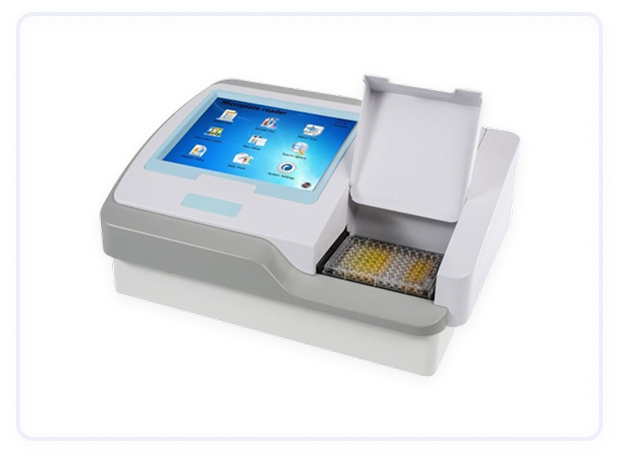
Elisa Plate Reader
An ELISA Plate Reader (also known as an ELISA Reader or Microplate Reader) is an essential laboratory instrument used to measure the absorbance, fluorescence, or luminescence in microplates used for Enzyme-Linked Immunosorbent Assay (ELISA) tests. ELISA is a commonly used laboratory technique to detect and quantify substances such as proteins, hormones, antibodies, and antigens in biological samples.
Key Features of an ELISA Plate Reader
Multi-Wavelength Detection : ELISA plate readers are capable of measuring absorbance across a range of wavelengths, typically from 340 nm to 750 nm. The reader can scan the plate at specific wavelengths to detect various reactions based on the substrate used in the assay.
High Throughput : These readers can accommodate 96-well or 384-well microplates, allowing for high-throughput screening in a single run. Some advanced models support higher well counts, such as 1536-well plates, for even larger-scale testing.
Automated Measurement : The ELISA Plate Reader automates the process of measuring the optical density (OD) of each well, which corresponds to the concentration of the analyte. This minimizes human error and enhances the accuracy and reliability of the results.
Versatility : ELISA readers can detect multiple types of signals such as:
Absorbance (the most common mode used for traditional ELISA assays)
Fluorescence (used in fluorescence-based assays)
Luminescence (used in chemiluminescent assays)
The ability to handle different assay types makes the ELISA plate reader a versatile tool in immunoassays.
Software Integration : Most ELISA plate readers come with accompanying software that automates data collection, analysis, and reporting. The software allows users to analyze results, perform calibrations, and generate custom reports with minimal effort. It can also help in setting parameters for assays, creating standard curves, and performing data normalization.
Customizable Settings : ELISA Plate Readers allow users to customize the measurement settings, such as wavelength selection, reading mode, and timing, to match specific assay protocols. This helps in optimizing the reader for different assay types.
Sensitivity : These instruments are designed to provide highly sensitive readings, capable of detecting low concentrations of target analytes, making them suitable for applications in medical diagnostics, drug discovery, and research.
Low Volume Requirements : ELISA Plate Readers require very small sample volumes, making them cost-effective by minimizing the need for large quantities of sample material.
User-Friendly Interface : Most modern ELISA plate readers have a simple touchscreen or computer interface that makes the operation intuitive, even for users with minimal technical expertise.
Various industries
Request More Information
Contact Us to learn more about our offerings or Request a Quote to get started today!
Contact Us

