
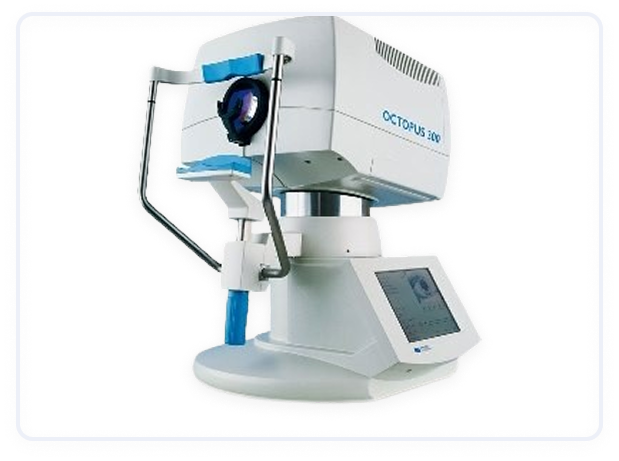
Perimeters
A perimeter is an essential diagnostic tool used in optometry and ophthalmology to measure the visual field of an individual, which refers to the entire area that can be seen when the eyes are focused on a single point. The perimeter helps in diagnosing and managing visual field defects associated with various eye conditions and neurological disorders.
Types of Perimeters
Manual Perimeter:
Description : The manual perimeter is an older, traditional device where a patient is asked to focus on a central target while visual stimuli are presented at different points around the visual field.
Process : The patient is asked to respond when they perceive a stimulus (usually a light) in their peripheral vision.
Limitations : While effective, manual perimeters are relatively less precise and require a trained clinician for accurate measurement and analysis.
Automated Perimeter:
Description : The automated perimeter is more commonly used in modern practice. It is a computerized version of the traditional perimeter that provides more detailed and accurate results. Automated perimeters are widely used for diagnosing conditions such as glaucoma and neurological disorders affecting vision.
Process : In an automated perimeter test, the patient is asked to look at a central point, and visual stimuli are presented at various locations within the visual field. The system automatically records the responses, producing detailed maps of the patient's visual field.
Advantages : Automated perimeters offer greater precision, provide more detailed data, and reduce the human error factor. The automated test is also faster and easier to use.
Various industries
Request More Information
Contact Us to learn more about our offerings or Request a Quote to get started today!
Contact Us

