
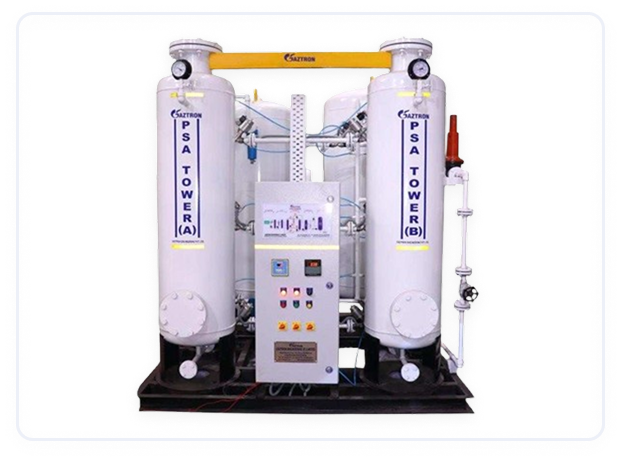
PSA Nitrogen Gas Plant
A PSA Nitrogen Gas Plant is an industrial system that uses Pressure Swing Adsorption (PSA) technology to produce high-purity nitrogen gas (N₂) from ambient air. PSA is a widely used method for separating nitrogen from other gases (primarily oxygen, carbon dioxide, and trace gases) in the air, producing nitrogen gas that can be used in various industries such as chemical, pharmaceutical, food processing, electronics, and oil & gas.
Key Components of a PSA Nitrogen Gas Plant :
Compressor :
The compressor draws in ambient air and compresses it to a higher pressure (typically 6–8 bar or 90–120 psi) to ensure that the air flows efficiently through the adsorbent beds during the separation process.
Air Dryer/Filter :
Before the air enters the PSA system, it is passed through dryers (e.g., desiccant dryers) and filters to remove moisture, dust, and other particulates that could damage the adsorbent materials and reduce the efficiency of the process.
Pressure Swing Adsorption (PSA) Unit :
The heart of the nitrogen generation system, where air is passed through two or more adsorption columns filled with carbon molecular sieves (CMS) or other adsorbent materials.
Separation Process : During the PSA cycle, air is compressed and passed through the adsorbent columns, which selectively adsorb oxygen and other gases, leaving nitrogen as the product gas. The nitrogen is collected and stored.
Pressure Swing : The key mechanism in PSA is the alternating high and low pressure stages:
Adsorption Stage (High Pressure) : Compressed air enters the first column, and oxygen and other gases are adsorbed by the molecular sieve, allowing nitrogen to pass through.
Resorption Stage (Low Pressure) : After a set time, the pressure in the column is reduced (usually by venting), and the adsorbed oxygen and gases are released to be vented out, regenerating the sieve for the next cycle.
Valves and Control System :
The PSA process relies on a precise sequence of operations controlled by valves, pressure sensors, and an automated control system. The control system ensures that the switching between high and low-pressure cycles occurs at the correct intervals to maintain consistent nitrogen production.
Storage Tank :
The nitrogen produced is typically stored in high-pressure storage tanks or buffer tanks to maintain a continuous supply. These tanks are designed to store nitrogen until it is needed, ensuring a stable flow of nitrogen even when demand fluctuates.
Purification System (Optional) :
For very high-purity nitrogen applications, additional purification units like PSA oxygen filters or membrane separators may be used to further remove trace oxygen or moisture from the nitrogen.
Distribution System :
Nitrogen is distributed from the storage tanks to the point of use through a piping system, which may include regulators and flow meters to maintain the correct flow and pressure.
How a PSA Nitrogen Gas Plant Works :
Air Intake : Ambient air is drawn into the compressor, where it is filtered and dried to remove contaminants such as water, particulates, and oils.
Compression : The filtered air is compressed to a higher pressure (typically 6–8 bar), which increases the concentration of nitrogen in the air and prepares it for the separation process.
Separation Process (Adsorption) :
The compressed air is passed through one or more adsorption columns filled with carbon molecular sieve (CMS). During this phase, the sieve adsorbs oxygen and other gases, leaving behind nitrogen, which passes through the column as the product gas.
Oxygen and other gases are adsorbed by the CMS, while nitrogen continues to flow out of the column.
Regeneration (Desorption) :
After a specific amount of time, the pressure in the column is reduced (venting), and the adsorbed gases (mainly oxygen) are released, Allowing the column to regenerate and be ready for the next cycle. This is known as pressure swing.
The columns work in tandem, with one column adsorbing gases while the other undergoes regeneration.
Nitrogen Storage : The nitrogen produced by the PSA system is stored in tanks until it is needed for use. These storage tanks help ensure that a constant supply of nitrogen is available, even during regeneration cycles.
Nitrogen Delivery : The nitrogen is then distributed through the piping system to the application points where it is required, such as in industrial processes, laboratories, food packaging, or chemical reactions.
How a PSA Nitrogen Gas Plant Works :
Air Intake : Ambient air is drawn into the compressor, where it is filtered and dried to remove contaminants such as water, particulates, and oils.
Compression : The filtered air is compressed to a higher pressure (typically 6–8 bar), which increases the concentration of nitrogen in the air and prepares it for the separation process.
Separation Process (Adsorption) :
The compressed air is passed through one or more adsorption columns filled with carbon molecular sieve (CMS). During this phase, the sieve adsorbs oxygen and other gases, leaving behind nitrogen, which passes through the column as the product gas.
Oxygen and other gases are adsorbed by the CMS, while nitrogen continues to flow out of the column.
Regeneration (Desorption) :
After a specific amount of time, the pressure in the column is reduced (venting), and the adsorbed gases (mainly oxygen) are released, Allowing the column to regenerate and be ready for the next cycle. This is known as pressure swing.
The columns work in tandem, with one column adsorbing gases while the other undergoes regeneration.
Nitrogen Storage : The nitrogen produced by the PSA system is stored in tanks until it is needed for use. These storage tanks help ensure that a constant supply of nitrogen is available, even during regeneration cycles.
Nitrogen Delivery : The nitrogen is then distributed through the piping system to the application points where it is required, such as in industrial processes, laboratories, food packaging, or chemical reactions.
Various industries
Request More Information
Contact Us to learn more about our offerings or Request a Quote to get started today!
Contact Us

